Nobody Likes Big Rats

Viola learned one harsh, inviolable, life-defining truth the hard way: Baby possums are adorable.

Adolescent possums...not so much.

She had been adored as a child. Revered, even. People stopped to coo at her in the streets and she was given treats by anyone who had a treat to give. Her parents fussed, her grandparents doted, and her aunts spoiled. A nice life, if you can get it.

But as her fuzzily sweet baby self grew into an ungainly rat-like creature whose whippy rodent tail dragged behind her, reaction to her person became far less enjoyable. It seemed that the other animals responded not to her sparkling personality, not to her ability to soothe fussy infants, not to the fact that she could recite every flower that grew within two miles of the village - alphabetically by name and genus, thankyouverymuch - but to her appearance.

People loved her when she was adorable, but were decidedly less interested when she grew into her tail.

Viola pushed her spectacles up her nose and glared at her fellow classmates. Her sharp eyes scanned the room. She was definitely the ugliest one between these - and let’s be honest, most - four walls. She wished she didn’t care so much. But it’s hard to go from toast-of-the-town to ignored-in-the-corner in just a few short years.

Noticing that her left lens was smudged, Viola whipped off her spectacles and polished them on her gingham dress. When she put them back on and the classroom swam back into focus, she saw a perfect pale face right in front of her, a little too close for comfort. Especially when that face was Fern’s, the prettiest bunny in the county. Viola’s eyes crossed as she tried to focus on the diminutive pink bunny nose two inches from her face.

Viola hated Fern. She hated her pink leather satchel, she hated the way her shiny whiskers floated and her silky ears lay down her back. She hated that Basin the badger was always sitting next to her in school. She hated that Fern was now sitting right in front of her, nose twitching expectantly, impossible to ignore.

“Will you help me with our spelling list, Viola?” Fern asked, rather anxiously. Viola was surprised. She just assumed that Fern had deigned to join her in order to mock her lank gray fur or perhaps the long, unattractive tail she kept curled under her seat. Just because Fern had never shown any penchant for being unkind didn’t mean today wasn’t the day.

Viola looked down at her own list, accurately spelled in her beautiful round hand. Viola spent hours perfecting her penmanship. Just because her face couldn’t be pretty didn’t mean she couldn’t make her homework so.

Fern took this as an invitation and sat in the empty seat beside her. “Flowers are so dreadfully hard to spell,” she said miserably, plopping her fuzzy chin in her paw. “Chrysanthawhat? Basin doesn’t know how to spell any of these either,” she said, as Viola’s entire frame tightened. “He sits next to me to help me with my sums because I’m hopeless at them, but he isn’t good at spelling and we’re both lost.” She gazed despondently down at her long bunny feet. “Can you help? You’re so good at school.” Fern looked up at Viola earnestly, her entire body quivering in hope.

Viola had her suspicions, but decided she was in no position to be choosy.

So she sat with Fern and Basin by the river every day after school, teaching them how to spell. By the day of the test, Viola had both Fern and Basin accurately spelling everything from anemone to quibble - and she had two new friends.

Fern and Basin didn’t care what she looked like. In fact, they were jealous of her tail and its ability to hit a croquet ball through the farthest wicket. In turn, Viola didn’t mind that Fern was hopeless with fractions or that Basin was late to everything. It meant she was useful - it’s nice to be useful - and that she and Fern could eat all the cake before Basin arrived.

True friends are in charge of loving what you don’t like about yourself, Viola thought, holding it for you until you learn to see it as they do.

---

This is the fourth in a collection of stories about animals who talk and drink tea and get themselves in trouble. The first story, about a fastidiously dressed raccoon named Randall, is here. The second, about a world-weary lemur named Mortimer, is here. The third, about mischievous wombat twins with terrible names, is here. These stories have become some of my favorite things in life, so I hope you enjoy them. 

Better Than Here

Death cracks you open. Watching someone you love take that final journey leaves you flattened and groundless. We don’t know what’s next for them. We can’t follow. We can’t understand how it feels to face the end of your life or the mental, emotional, and physical territory that comes with it. I don’t believe that those who die are lost. I don't believe that we're purely biological lights that flicker out when bodies give up. I believe we have an essence. A soul, if you will, that soldiers on after our body gives up. But it's a very human thing to want proof and science still doesn't know quite what to make of death. So each of us has to choose what we believe - and then, more importantly, choose what to do with that belief.

Sitting in the car with my father and talking about god is one of my earliest memories. I told him I didn't believe in any religion that taught us to fear god, because I didn't think god worked that way. His reply didn't survive my precarious and sieve-like memory bank, but I remember feeling like he was proud of me.

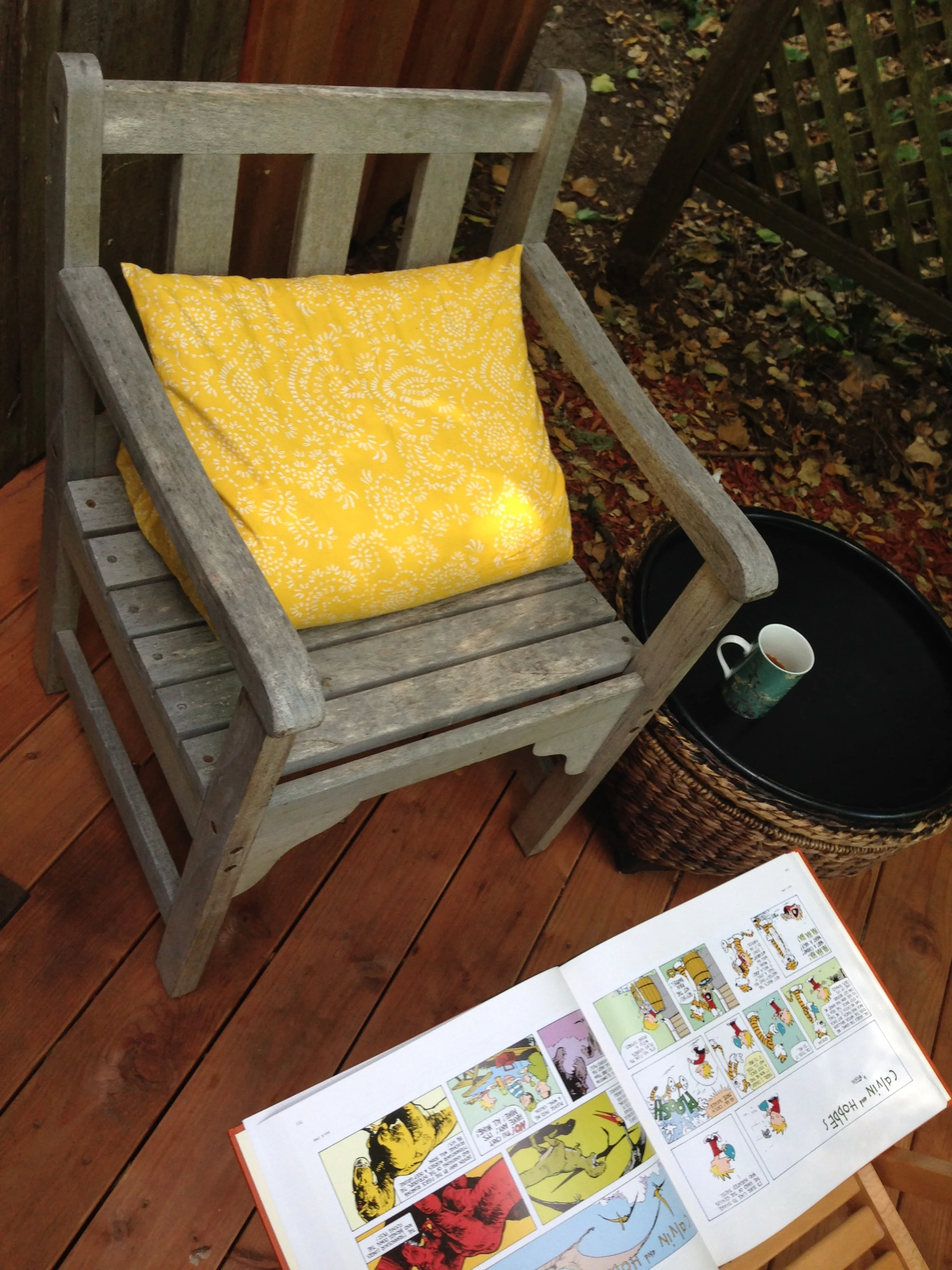
He's also proud of me for this - deep, life-long commitment to Calvin and Hobbes, his favorite comic. 

He's also proud of me for this - deep, life-long commitment to Calvin and Hobbes, his favorite comic. 

The idea of god as a judgmental white-bearded dude in the sky never seemed quite right. One night when I was young, seven or eight maybe, I decided that god was made of people - the best parts of people, what we are at our purest and most loving. I saw each person as a bright pinprick of light, like a star. I remember deciding that we’re our own individual sparks here in this body, in this life. But when we die, our light gathers and joins that of everyone else in a much larger light, bright and vast. God as a separate entity doesn’t exist, because we are all god.

I’m not sure where this came from - maybe I absorbed this idea from the metaphysical books that lined the shelves of our living room when I was growing up, maybe it was a burst of intuition that came through before my brain and ego began to shut me down, maybe I invented it because it seemed like a nice idea. But I remember feeling comforted by the idea of a great light to return to as I lived my relatively average but not exempt from pain life.

But when your father is dying, all you can do is feed him ice cream when he asks for it and play John Coltrane you’re not sure he can hear and then send him off into the deep unknown and trust that whatever comes next is better than where he was.

Crazy Wombats Pack Terrible Lunches

“Why, why, why?” A small wombat banged his head steadily against the flat surface supporting his lunch, as if blunt trauma to the forehead via wooden picnic table would give him answers.

His twin brother rolled his eyes and dug into his lunch pail. When his paw emerged with a handful of wriggling worms rather than the anticipated peanut butter and strawberry jam sandwich, his mouth dropped open and he considered joining his brother’s woeful genuflection.

It was generally acknowledged that the twins' mother was insane. For one thing, she named her boys Scanket and Blarf, an unholy homage to her two favorite knitting projects, a blanket and a scarf. That she turned around and gave the blanket and scarf the stolidly respectable names of Wilbur and Whitby was only insult to injury.

“Even her knitting has better names than we do,” Blarf grumbled to his brother after their mother proudly introduced them to her newest sweater, which she had named Charlotte. “I’d take Charlotte over Scanket any day,” his brother whispered back - a telling statement given the swaggering machismo he’d recently adopted. Thankfully, his swagger quickly disappeared the second they needed to make a quick getaway.

“But what can one expect from wombats named Scanket and Blarf?” the townspeople would say to each other, shaking their heads ruefully after the twins had filched yet another box of chocolate bars or bottle of raspberry cordial. When caught, the brothers would be reprimanded and put to work to pay off their misdeeds. But this only served to make them craftier, not more honest.

Despite their unfortunate names, Scanket and Blarf cut quite a swath at the village school, bestowing sweet treats on the lucky animals in favor that day and smirking at everyone else. Everyone wanted to be on the good side of the wombat twins and not just because they had access to all the best desserts.

“Why worms?” Blarf moaned. “She promised us peanut butter and jam today.” Scanket shook his head at his naivete. Sure, their mother may have promised a normal noon meal while snuggled up by the fire, knitting needles clacking away between her paws, but inevitably she would wake in the deep of night, caught by a feverish notion that told her earthworms would be far healthier for growing wombats. In her mad haze, she’d rush out into the dew-laden, moonlit garden, dig some up some unsuspecting garden pests, drag them back into the kitchen, and label them a meal.

“She’s daft, Blarf,” his twin said prosaically, before wandering over to the nearest picnic table and confiscating a tuna fish sandwich and an onion tart from two classmates who had fallen from favor. Blarf still longed for a normal mother, one who didn’t name her knitting and baked cookies instead of kale. Scanket simply adapted, creatively augmenting their meals and choosing to find their mother's lunacy amusing. He knew she loved them, she just had odd ideas about how to show that love, he thought as he emptied his pail of worms into the schoolyard garden.

After the usual round of afternoon admonishments from the teacher, the animals streamed out the school house doors. Blarf veered off to the side and began pulling things out of his knapsack. “Knitting needles, two sets,” he mumbled. “Red blankets and safety pins, check.” After watching his twin blankly, Scanket asked for instructions. Blarf had terrible and wonderful ideas and Scanket was always on board.

Tugging the requested wagon behind him - he didn't even have to steal it, it had been abandoned in the lane three days ago - he saw that Blarf had donned a uniform for mischief. Knitting needles poked out of his hat like bug antenna and a red blanket was swirled around his neck. He handed Scanket a set of knitting needles and another blanket, this one a cheery yellow.

Snapping on his goggles, Blarf climbed into the wagon and demanded that Scanket push him to the top of the lane, where the red brick curved downward in a steep trajectory to the town square. Poised over the precipice, Scanket gave the wagon a mighty shove and jumped in behind his brother.

Red and yellow capes flew out behind them as the wind whistled through their antenna. The village was reduced to a blur of color and sound and Blarf laughed for the first time in a week, the sound pealing out behind them as they ricocheted around corners and narrowly missed a shopkeeper sweeping his stoop. Scanket gave a mighty whoop and a cluster of chattering magpies quickly dispersed as they slammed to a halt at the bottom.

Hopping out and grinning at the open mouths of the animals in the square, Blarf started pulling the wagon up the hill for another ride. Until Scanket saw the curious faces of the schoolmates who gathered around, and a fully formed scheme jumped into his head as if sent down from above.

The twins made one pound, three shillings, and five pence - enough to keep them in jam and peanut butter for weeks - before a wagon carrying two caped rabbits and a young vole brandishing knitting needles crashed into Randall and the raccoon, proving himself terribly fussy about bruises and knocked-askew scarves, shut the operation down.

---

This is the third in a collection of stories about animals who talk and drink tea and get themselves in trouble. The first story, about a fastidiously dressed raccoon named Randall, is here. The second, about a world-weary lemur named Mortimer, is here. These stories have become some of my favorite things in life, so I hope you enjoy them. 
Ask For a Sign and You'll Get One

Turns out, I'm not going to live forever. It also happens that if I want children, my childless days will be coming to a rapid halt in the very near future. I'll be 37 in July, guys. Which gives me a rather short span of time to do everything I want to do ever before kids muck it all up. So in the next year or two, I need to have many amazing adventures, spend a month in Bali and France, learn how to earn a lot of money while also having plenty of time to hang out with babies, and, I dunno, buy a house or something. It's a hefty to-do list. What does a person do when they suddenly realize they don't have forever to do all the things they want in life? If you're me, you decide to devote yourself wholeheartedly to writing animal stories, and pretending you have answers on youtube. Because animal stories are obviously the way to get to Bali and also have plenty of money to pay for babies. Cough.

I'm forging a path that doesn't necessarily make good, common sense. Do I believe it's possible to have what I truly want in life? Absolutely. Do I have any idea how to do it? Nope. But to build the life you want, one that doesn't necessarily look like everyone else's, you have to listen to yourself. You have to get really clear on what you truly want to do, what you truly have to offer, and offer it up in the best way you can in that moment. 

I have anywhere from one to three years to make a lot of things happen for myself before it's baby go-time. It feels more possible than ever, but only if I follow my intuition. Because that's the only thing that can tell me how to get where I really want to go. 

I literally wrote the book on freelance writing (fine, one of the many books on freelance writing), but I've started to realize that freelance writing isn't actually what I want to do. I don't want to write for other publications, I don't want to hustle, I don't want to pitch. It exhausts and drains me and it's taken me fifteen years to admit that. In Turning Pro, Steven Pressfield talks about shadow careers, about career paths that resemble what you want to do but are really just a form of resistance. I've been resisting what I actually want to do for a decade and a half now. In many ways, I do love freelance writing. I love talking to people about their jobs and their passions and their businesses and I love writing about burlesque dancers and chefs and mountain climbers and canny CEOS. And I will happily continue to do it until what I actually want to do begins to make sense in the real world.

Here's the paradox: In order for writing animal stories to make sense as a career choice in the real world, I have to abandon the real world. I have to allow myself to dream in a way that felt foreign even just a few months ago. Because I want to be an artist - yes, a writer, but not a writer in any of its more professional, practical forms. I want to write ridiculous stories about talking raccoons who wear cravats and go on adventures. I want to channel for people, something that I still have trouble saying out loud because what?

Owning what you really want isn't always easy, especially when what you really want wouldn't make sense to most people you pass on the street. But that just makes it even more essential that you do it. We need the strange and unconventional and creative in this world now more than ever. Because if we keep doing it the way we've always done, we'll keep getting what we've always gotten.

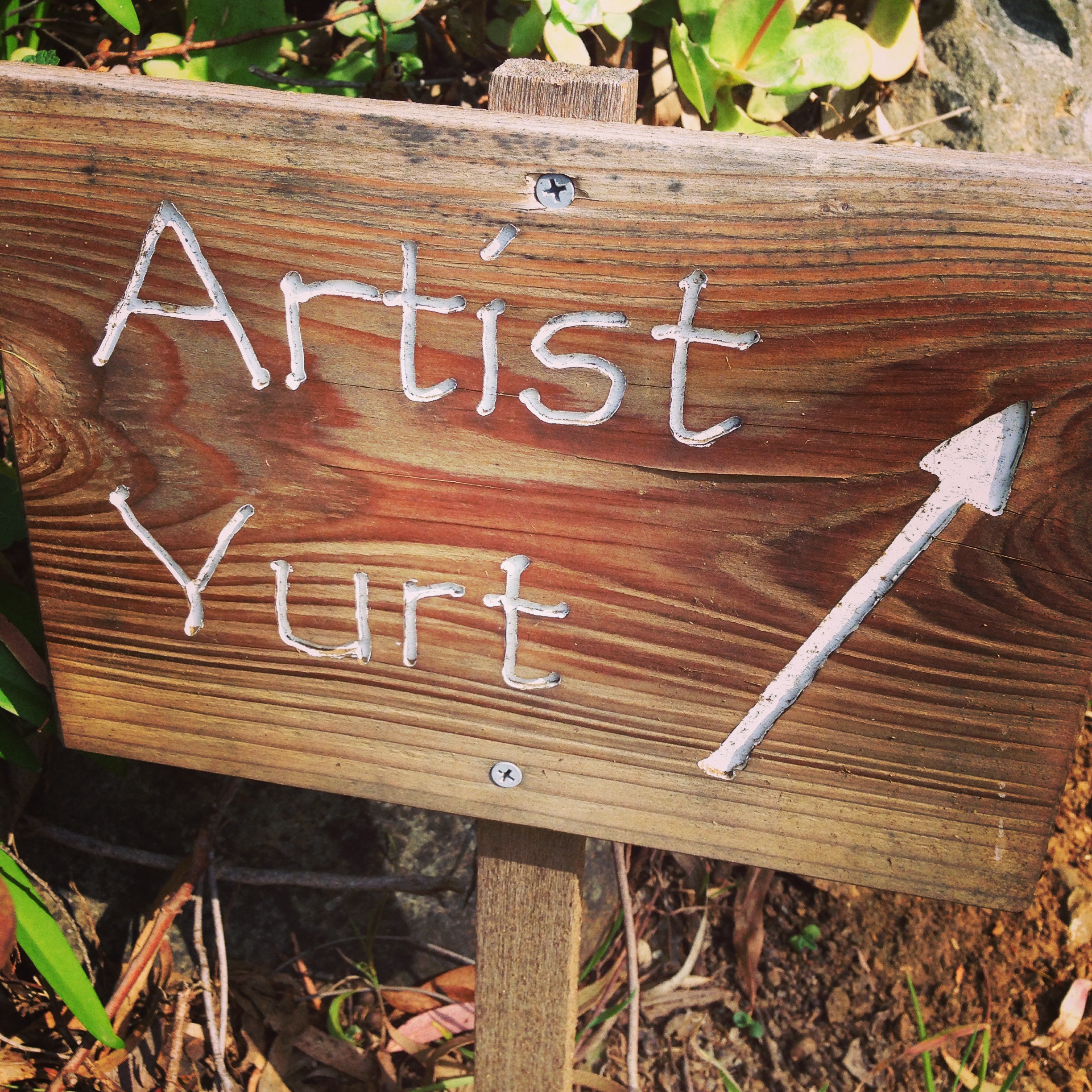
Last week, we drove along the coast of California until we hit Esalen in Big Sur. When we pulled up to the gate, they handed us a key that sent us here:

photo-6
photo-6

Sometimes the universe sends you a literal and unmissable sign, and that sign says, "Go right ahead and be an artist, you irrepressible hippie, you." And so I shall.